
Remembrance
after February

I wish I was home before two on a weekday afternoon so I could witness how the sun hits the window differently, but after-school runs until six, and I can only dream about the daylight at that hour, staring up at the glass ceiling from the carpeted staircase where I would lie for hours, with my head over my feet, eyes stamped to the sky. Here it was: one day my third grade teacher showed us a sundial he drew out of white chalk on the cement next to the playground where the kids played during recess. Every hour, my classmates and I would run out to the playground and marvel at the shadows statued beneath our feet, where my teacher marked with white chalk. What later occurred to me, or at least grew to a point of tragedy for me, was the spaces in between the marks where I had not—could not—bear witness to. Evidence of time drawn out, summarized by stasis.
Another flash cut:
In early March of 2006, a child perches herself on the couch with Tom and Jerry playing on the Sony CRT TV tucked in the corner of her dad’s office room with a remote quivering in her palms. She breaks down in tears. She senses the room as gray though she sees and remembers blue. Pivot to the screen: every few seconds, the scene rewinds and plays. The screen enjoys some sort of cosmic reversal, flurried and actioned upon the palindromic. Jerry, the mouse, appears to back-sprint towards Tom, the cat, as Tom hurls away. The scene plays out comically. The room, as recalled upon writing, seems to be deafeningly silent, color gouged out. She finds the impossible utterly devastating: the tenth of a second lost to a blink of an eye, which she takes to be the end of the world.
The child is me. I had actually forgotten about the devastation the next day and alighted on another impossibility where I was bent on the same staircase with the glass ceiling, where for hours I would bring my palm to the ceiling and cup the light, most spectacularly, a rainbow after the sky finishes with rain. Perhaps because I have spent some early rapport with the sun, with my head resting on the staircase, as I stare up at the small opening from the high ceiling, where seasons pass and time heaves slow and hypothetical. I consider the sun that day weighing its proximity to me and how lovely everything is when that is the case, and how I wish I could return to that day again.
Later in my twenties, I am becoming like necessity. I am thrown back into the compulsion of obsessing over everything I see and feel and do. The mania, that is the world, spits out things I cannot unsee: glorify the body, infuriate the politics. Why is it that I desire becoming the superlative, the seer and judge of all. I crunch into the pixels of my phone, and I recall everything I know, which is to say, you do not think it is common knowledge that we are losing control over attention.
But it is easy. I tell myself I need to witness everything. The instant is right here. It is not. I deepen the words as if by some fundamental urgency. I photograph each juncture. I swallow the brain rot. I participate in this delusion. There’s a part of me that wishes to scour meaning in media, in television, in social media, perhaps beneath it all is finally something that is forever and sacramental, if only in revealing us. I wonder if this is what is desired.
During my gap year after graduating from college, I stayed in Taiwan for a month and a half. I grew up entirely in this town inside a drug store my grandma runs, sandwiched between a Kodak photo store and tea stand. I think about mosquitoes and mangos but it is January and they do not ripe in this season, so my grandpa cuts up a pear. There’s a part of me that wishes to relieve the anxiety of my ancestors and suggest some range of disposition that goes just beyond diplomacy. What of, madness. I was weighted with sleep. But I ate the pear in love-sucking bites.
It is still January but I am with family at a Lunar New Year buffet in the Grand Hyatt Hotel in Taipei. It is not like Sunnyvale where I grew up. I wish I could remember everything. I remember the foot-long shrimp and the wasabi sauce that made me cry. Grandma said she recognizes the family of shrimp that grew up in Penghu, where Dad was stationed in the army and operated a tank. She said he missed him, and she misses him now: that he is just like her, mother and son. We only visit every two years.
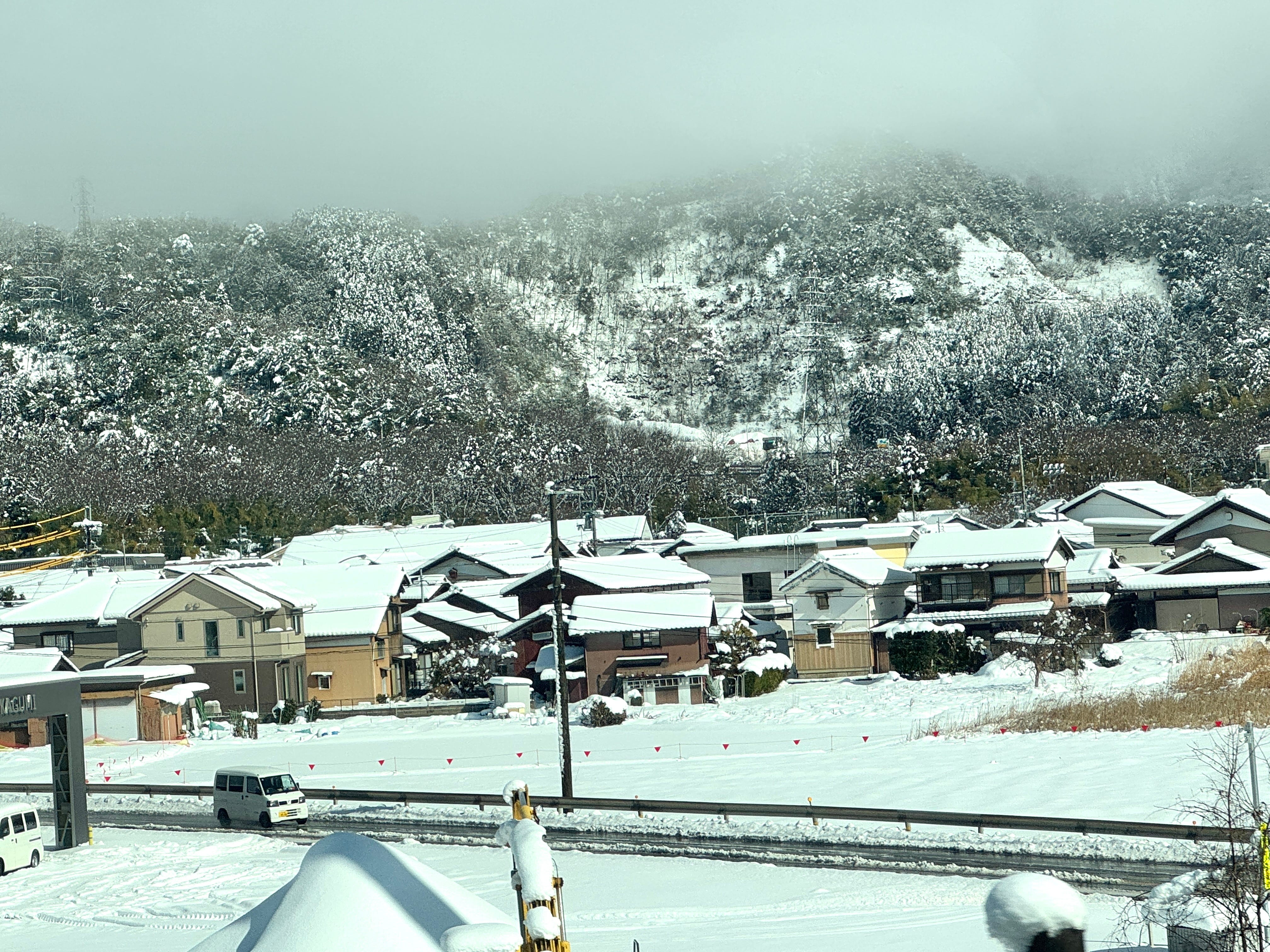
I think about the moments I like to hoard, like when a man chased a dog in a snowy field from the window on the Shinkansen between Hiroshima and Tokyo later in February. It was somewhere in Hikone. It is recorded somewhere on my phone, where I store memories now. I don’t have the photo of the man chasing the dog, but I have a photo that looks like where the man chased the dog. I think it was taken a few seconds after. I don’t know. I find the geotag on my phone to be a nice addition to sounding like I have it all down. They just don’t move anymore, the pictures in my brain, all static and grand, like the photos in the album. I wonder what that means. Later this particular interiority comes up in a dream, and it finally moves. I’m writing more again, and my words begin to gather sustenance, life even. Poetry and memory come to me in my sleep, and I forget to write them down, but the feeling remains.
This is beautiful Melody. I love the way you weave these moments together under the common theme of having to witness everything. Makes me reflect on that feeling as well, and how there's an urge of not wanting to miss even the slightest moment. Brilliant as always!! Keep it up, I'm always looking forward to the next pieces.
so beautifully written Melody!